


Finding Calm: How to Help Struggling Readers Focus in a Busy Home
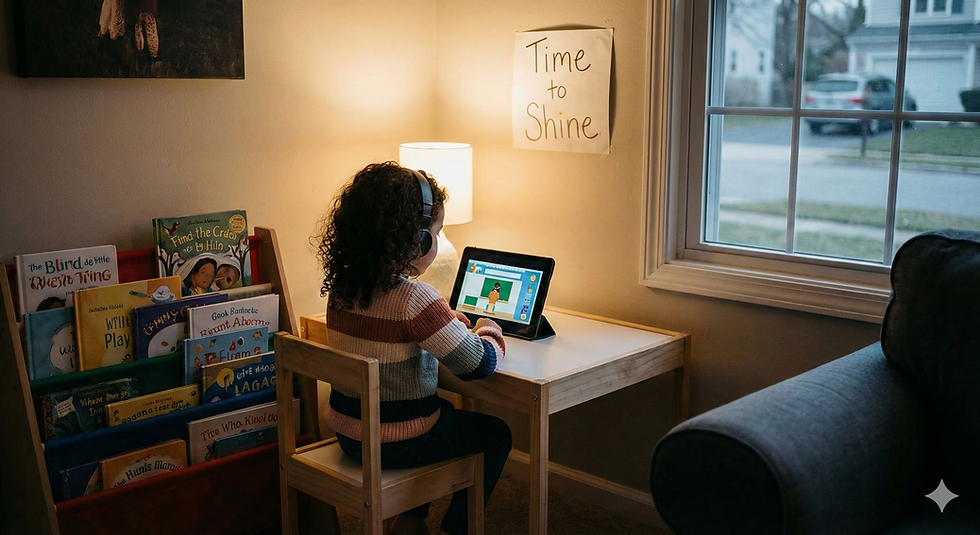
Life with children is a beautiful, whirlwind adventure. Between soccer, ballet, play dates, and the general hum of a full house, finding a moment of stillness can feel like a tall order. We know that many of our families are "on the go"—logging in from the car or squeezed between a sibling’s nap time and dinner prep.
However, when it comes to the Reading Room, the environment we create is just as important as the lesson. Our goal in The Reading Room is to help struggling readers focus by providing them with the tools—and the environment—they need to succeed.
1. The Science: Why Quiet Spaces Help Struggling Readers Focus
Learning to read is one of the most complex tasks we ever ask a child’s brain to do. For a student who finds reading difficult, background noise isn't just a distraction—it’s a barrier.
When a child is in a calm, quiet space, their brain can dedicate its energy to decoding sounds and letters and understanding what they read. If there is a TV in the background or siblings playing nearby, the brain has to work twice as hard just to filter out the noise before it can even begin to "learn." A quiet bedroom or a dedicated desk space where they can be alone is always the gold standard.
2. The "Stationary" Rule
We know those after-school transitions are tight! However, we strongly encourage families to avoid logging in from the car. The movement, the shifting light, and the ambient road noise make it difficult for a child to settle into the deep focus required for their session. Our teachers also need a crystal-clear audio environment to hear the subtle sounds your child is making. If a "car session" is your only option on a certain day, please try to minimize noise (park if you can) and make sure your child can sit comfortably with minimal distractions.
3. Creating a "Quiet Cue" for the Whole Family
If your child needs to work in a shared family space, you can still create a "Learning Sanctuary" through a few simple cues:
The Music Signal: Put on some soft, quiet classical music. This acts as a signal to the whole family (especially siblings not in the program) that it is "quiet time" for everyone.
The Silent Shadow: Encourage siblings to engage in their own silent activities nearby—reading a book, drawing, or doing their own homework. When the house slows down together, the student feels supported rather than isolated.
The "One Voice" Rule: During a Power Session, the teacher and your child must be the only two people talking.
4. Let Your Child Shine
It is so tempting to jump in and help when you see your child struggle with a word or a question. We’re parents—it’s our instinct! But in the Reading Room, we want your child to take the lead. This is their time to shine and build a direct, confident relationship with their teacher.
We ask that family members refrain from joining the conversation or "coaching" from the sidelines. Letting them navigate the challenge is where the real growth happens.
5. We’re Always Here to Chat
If a session sparks a question or if you have an update you’d like to share with Ms. Laura, we want to hear it! To keep the lesson focused entirely on your child, please refrain from sharing during the session. Instead, you can always text Heather. She can field your questions or put you in touch with a member of our team directly.
Thank you for being such an incredible partner in your child's journey. We know how much effort it takes to carve out these quiet spaces, and we see the difference it makes in your child's progress every single day!


Comments